Why are there so few LGBTQ stories?
By Chandler Garcia November 24, 2025 Updated onNovember 24, 2025
For many transgender and nonbinary people, representation in media and literature is far and few. While studies like “Emotional Content of Social Representations and Interpersonal Communication” by the International Review of Social Psychology show that people greatly benefit from seeing themselves represented positively in media and society, there still remains a lack of representation and stories surrounding queer people people of color. While there is no definitive number of literature containing queer people of color; roughly 25% of banned books feature LGBTQ+ identifying characters with 36% of banned books featuring primary characters of color according to PEN America.
To say that there are very few stories featuring LGBTQ+ people of color would be incorrect. But to say that there is very little access to these stories would be factual. While gay, lesbian, and bisexual identities see the most representation in literature and even garner large fanbases, the same cannot be said for transgender and nonbinary identities.
There do exist popular and renowned novels and memoirs detailing the lives of and representing transgender and nonbinary people, more so for transgender women than any other identity, a large majority of these stories focus on people who are not of color. Additionally, these stories tend to follow the same narrative, without much positivity to give to a reader as they rely on medical transition to operate as the narrative resolution while there is a constant struggle with gender identity, expression, and mental health. The issue exists not just in what authors are writing and what people are reading, but also in what publishers are willing to promote and produce.
What Stories Get Told?
Professor Rusty Rust, an English lecturer at California State University, Long Beach, alluded to the fact that the struggle in queer literature’s accessibility is in large part due to lack of access to more diverse voices in the publishing field. Diverse in not only gender identities, but in cultural identities, ethnicities and narratives. Many more well known and accessible pieces of literature focusing on LGBTQ+ people, specifically in the case of transgender identities, are about or are focused on white people.
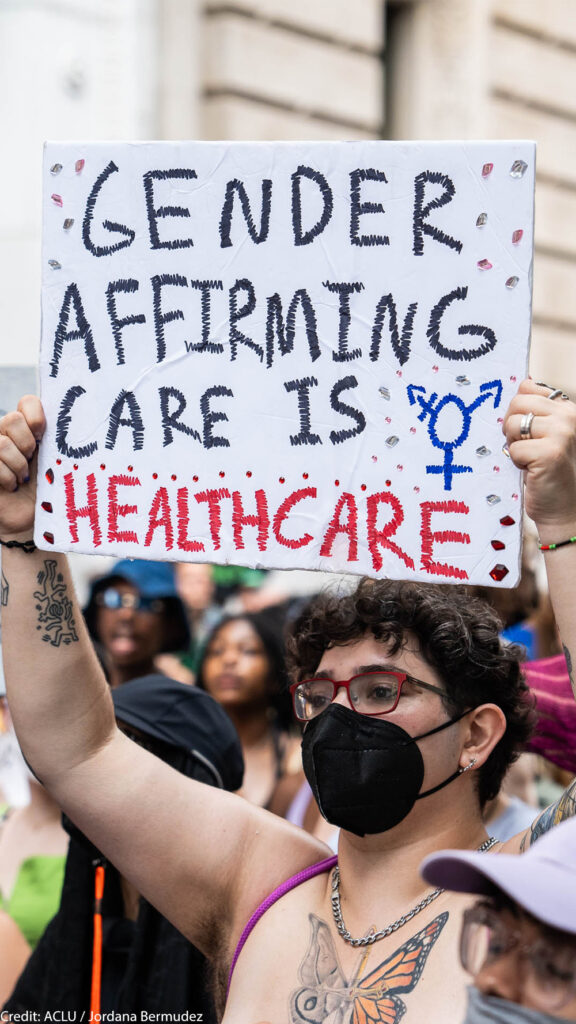
Transgender rights protester by ACLU
Because stories about the experiences and lives of transgender people are so few, representation is sparse and only certain narratives get to be told on a large scale, garnering them more access to the general public. Professor Rust explains that a large portion of popular transgender representation follows a similar narrative, that the ultimate goal is assimilation to a heteronormative and binary society. This is largely due to “trans identity [being] so dependent on medical access, insurance and having a legible story.” according to Professor Rust. Diverse voices from people of color telling narratives that attempt to take transgender people out of a narrative box often do not get published because they are more likely to not have the experiences of this narrative. As society as we know it currently operates in a binary and heteronormative way, the stories of trans people that do not align with the male or female binary, such as non-binary people who identify as neither male or female, are not given accessibility that a binary experience would have.
What’s Left Unsaid?
To equate transgender identity to medical transition and interventions largely restricts the types of stories and voices of transgender people, as medical transition is not only extremely inaccessible, but does not tell the full story of transgender lives. Because of this small representation of trans experiences, what is left out, according to Professor Rust is “what gender is to the person…and recognitions of gender happening with people in their sphere” which paints a larger and clearer picture of the lives and experiences of trans people and what their identity means to them outside of physical expressions of gender.
Because being transgender is not only about medical transitions and interventions, and may not include any medical interventions for some people, the stories and therefore representation of trans and nonbinary identities are extremely confined. When this representation is confined, an already extremely marginalized group seems to become even more marginalized and separated, causing all types of trans people, especially trans people of color to not be seen.
Professor Rust raises the fact that the issue of this confined image of trans people creates the belief in those who are not trans that medical transition “solves the issue with gender” and fails to show that the issue is “how society is imposing strict gender regulations and expectations on bodies that should not be as regulated as they are and sometimes transition doesn’t solve that.”
These types of narratives that garner the most access and publication are generally what anyone who is not trans and does not know anyone who is, have to understand and educate themselves on trans identities. This is why diverse voices and narratives matter so greatly to a population that makes up less than 1% of the general population as it helps them to not only feel seen, but to possibly feel less restricted in an imposing and heteronormative society.
While stories about trans and nonbinary identities are not non-existent, the most accessible ones do not fully represent what it means to be and live as a trans person, let alone a trans person of color. In order for trans and nonbinary people of color to gain more representation and compassion from society, diverse narratives and representation need to be published and accessible on a larger scale.